
Artificial intelligence has quietly transformed the way businesses communicate with customers. A few years ago, chatbots were little more than automated FAQ tools that frustrated users with scripted responses and limited capabilities. Today, that perception has changed dramatically.
Modern AI chatbots are no longer designed simply to answer repetitive questions. They have evolved into intelligent digital assistants capable of understanding context, learning from conversations, recommending products, qualifying leads, scheduling appointments, and even helping customers make purchasing decisions.
For businesses competing in an increasingly digital marketplace, this shift represents more than just a technological upgrade. It has become a competitive advantage.
Companies that embrace AI-powered customer engagement are finding new ways to reduce operational costs while improving customer satisfaction and generating more sales. Those that continue relying solely on traditional support channels often struggle to keep pace with rising customer expectations.
Customers Expect Instant Answers
Imagine visiting an online store late at night because you’re ready to purchase a product. You have one simple question before checking out, but there is no one available to answer it.
What happens next?
In many cases, you leave the website and look elsewhere.
This scenario happens thousands of times every day across e-commerce stores, SaaS platforms, service businesses, and online marketplaces.
According to multiple customer experience studies, modern consumers expect businesses to respond within minutes—not hours. Every delay increases the likelihood that a potential customer will abandon their purchase or choose a competitor.
Hiring support staff to provide around-the-clock assistance is expensive, especially for startups and small businesses. Maintaining multiple shifts, training employees, and ensuring consistent service quality quickly becomes a significant operational cost.
This is where AI chatbots are changing the game.
Unlike traditional support teams, an AI chatbot never sleeps. It doesn’t take breaks, call in sick, or become overwhelmed during peak traffic. It is available every hour of every day, ready to assist visitors the moment they arrive.
From FAQ Bots to Intelligent Sales Assistants
The biggest misconception about AI chatbots is that they exist only to answer customer questions.
In reality, the newest generation of conversational AI is capable of supporting the entire customer journey.
Instead of following rigid decision trees, advanced AI models understand natural language, maintain conversational context, and generate responses that feel remarkably human.
A modern AI chatbot can:
- Welcome new website visitors automatically.
- Answer product and service questions instantly.
- Recommend products based on customer needs.
- Collect contact information from potential buyers.
- Qualify leads before handing them to the sales team.
- Schedule meetings and consultations.
- Provide multilingual customer support.
- Assist customers throughout the buying process.
- Reduce repetitive workloads for support teams.
Rather than replacing human employees, AI works alongside them, allowing staff to focus on complex customer interactions while routine conversations are handled automatically.
The result is a faster, more efficient customer experience that benefits both businesses and their customers.
Why Businesses Are Investing in AI Customer Support
One of the primary reasons companies adopt AI chatbots is scalability.
As businesses grow, so does the number of customer inquiries. Expanding a support team requires hiring, onboarding, training, and ongoing management.
An AI chatbot scales almost instantly.
Whether your website receives 50 visitors per day or 50,000, the chatbot can engage every customer simultaneously without increasing staffing costs.
This makes AI particularly valuable for:
- SaaS companies
- E-commerce stores
- Marketing agencies
- Real estate businesses
- Educational platforms
- Healthcare providers
- Financial services
- Online communities
Every interaction becomes an opportunity to build trust, answer questions, and guide visitors toward the next step in their journey.
AI Chatbots Help Increase Sales, Not Just Reduce Costs
Many businesses initially invest in AI to lower operational expenses.
What often surprises them is the impact on revenue.
A well-trained AI chatbot doesn’t simply answer questions—it actively helps customers make decisions.
Imagine someone browsing your pricing page but hesitating to purchase.
Instead of leaving without taking action, the chatbot can ask thoughtful questions, explain the differences between available plans, highlight relevant features, and recommend the most suitable option.
If the visitor isn’t ready to buy immediately, the chatbot can collect their email address, schedule a product demonstration, or connect them with a human sales representative.
Every conversation becomes an opportunity to convert interest into action.
Instead of acting as a passive support tool, AI becomes an active contributor to the sales process.
Building Trust Through Better Conversations
One concern businesses often have is whether customers are comfortable talking to AI.
The answer depends largely on the quality of the experience.
Early chatbots frustrated users because they relied on predefined scripts and failed whenever conversations became more complex.
Today’s AI models understand intent rather than simply matching keywords.
They can explain products naturally, answer follow-up questions, remember previous messages within the conversation, and adapt responses based on customer needs.
When implemented correctly, many users don’t mind whether they’re speaking with AI or a human. What matters most is receiving accurate, helpful, and immediate assistance.
Businesses that prioritize conversational quality often see improved customer satisfaction, longer engagement times, and higher conversion rates.
Choosing the Right AI Chatbot Platform
Not all AI chatbot solutions are created equal.
Businesses should look beyond basic automation and consider platforms that integrate naturally into their existing workflows.
A modern AI chatbot should offer:
- Human-like conversations powered by advanced AI models.
- Custom knowledge base training.
- Multi-language support.
- Lead qualification capabilities.
- CRM integration.
- Analytics and conversation insights.
- Human agent handoff when necessary.
- Easy deployment across websites and messaging channels.
Platforms such as Pendy are helping businesses move beyond traditional customer support by combining AI chatbots with marketing automation, social media management, and intelligent business workflows in a unified ecosystem.
Rather than treating customer conversations as isolated interactions, businesses can use AI to connect support, marketing, and sales into a seamless customer experience.
Learn more about how AI-powered business automation can help your organization at https://pendy.io/.
Teaching AI to Understand Your Business
One of the biggest advantages of modern AI chatbots is that they no longer rely on generic responses. Instead, they can be trained using your company’s own knowledge.
This means the chatbot can learn about:
- Your products and services
- Pricing information
- Company policies
- Frequently asked questions
- Internal documentation
- Sales materials
- Knowledge base articles
- Product manuals
- Support documentation
Instead of searching through predefined scripts, AI understands the context of customer questions and generates responses based on the information you’ve provided.
For customers, the experience feels much more natural. Instead of receiving robotic answers, they receive detailed, relevant information that closely matches what a human sales representative or support specialist would provide.
As your business evolves, the chatbot can continue learning from updated documentation, allowing it to become increasingly knowledgeable over time.
AI Chatbots Are Becoming Part of Every Customer Journey
Customer communication no longer happens in one place.
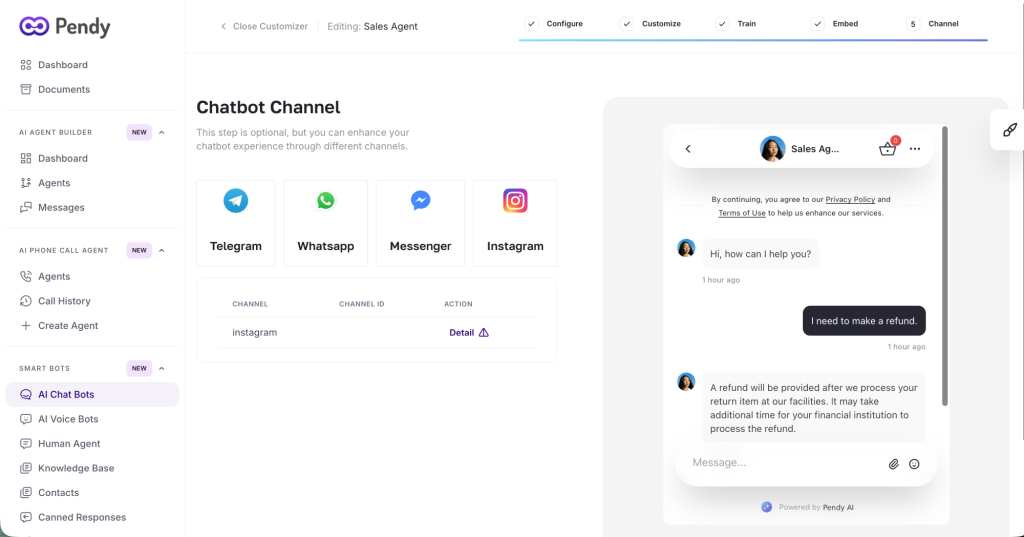
People interact with businesses through websites, Facebook Messenger, WhatsApp, Telegram, Instagram, mobile apps, and many other digital channels.
Maintaining a consistent customer experience across all these touchpoints is one of the biggest challenges for modern businesses.
An AI chatbot acts as a central communication layer.
Whether a customer visits your website, sends a message through social media, or contacts your business after office hours, they receive immediate, consistent support.
This unified experience builds trust because customers don’t need to repeat themselves every time they switch communication channels.
For businesses, it also creates valuable customer insights that can improve future marketing campaigns and sales strategies.
AI and Human Agents Work Better Together
Some business owners worry that implementing AI means replacing human employees.
In reality, the opposite is often true.
The most successful companies use AI to enhance their teams rather than replace them.
Routine conversations—such as checking business hours, explaining pricing, answering frequently asked questions, or collecting customer information—can be handled automatically.
When conversations become more complex or require personal attention, the chatbot can seamlessly transfer the customer to a human representative.
This approach offers several advantages:
- Faster response times
- Reduced workload for support teams
- Higher employee productivity
- Better customer satisfaction
- Improved sales efficiency
Instead of spending hours answering repetitive questions, human agents can focus on building relationships, solving complex problems, and closing high-value deals.
Measuring Success Beyond Response Time
One common mistake businesses make is evaluating AI chatbots based solely on how quickly they respond.
Speed is important, but it is only one part of the equation.
A successful AI chatbot should also contribute to measurable business outcomes, including:
- Increased website engagement
- Higher lead generation
- More qualified prospects
- Better customer satisfaction
- Reduced support costs
- Higher conversion rates
- Lower response times
- Improved customer retention
Modern chatbot platforms provide detailed analytics that allow businesses to understand customer behavior, identify common questions, and continuously improve conversational performance.
These insights become valuable not only for customer support but also for product development, marketing, and sales optimization.
A Smarter Way to Build Customer Relationships
As artificial intelligence continues to evolve, customer expectations will continue to rise.
People increasingly expect businesses to be available whenever they need help.
They expect personalized conversations rather than generic automated responses.
They expect companies to understand their needs quickly and recommend the right solutions without unnecessary delays.
Businesses that fail to meet these expectations risk losing customers to competitors that offer faster, more intelligent digital experiences.
An AI chatbot is no longer simply a support tool—it has become an important part of the overall customer experience.
Why Businesses Are Choosing Pendy
Choosing the right AI platform involves more than selecting a chatbot.
Many organizations eventually discover they also need marketing automation, social media management, content generation, analytics, customer segmentation, and workflow automation.
Managing these capabilities across multiple disconnected platforms often increases complexity and subscription costs.
Pendy approaches this challenge differently.
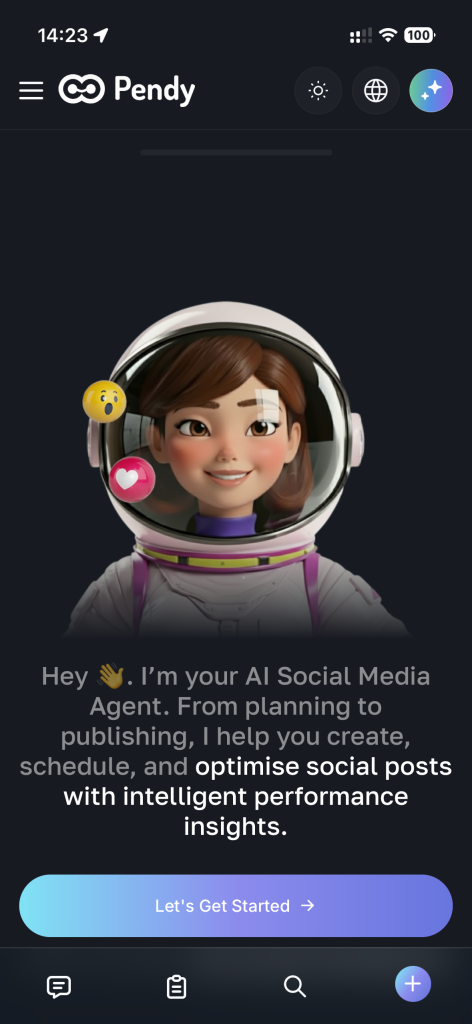
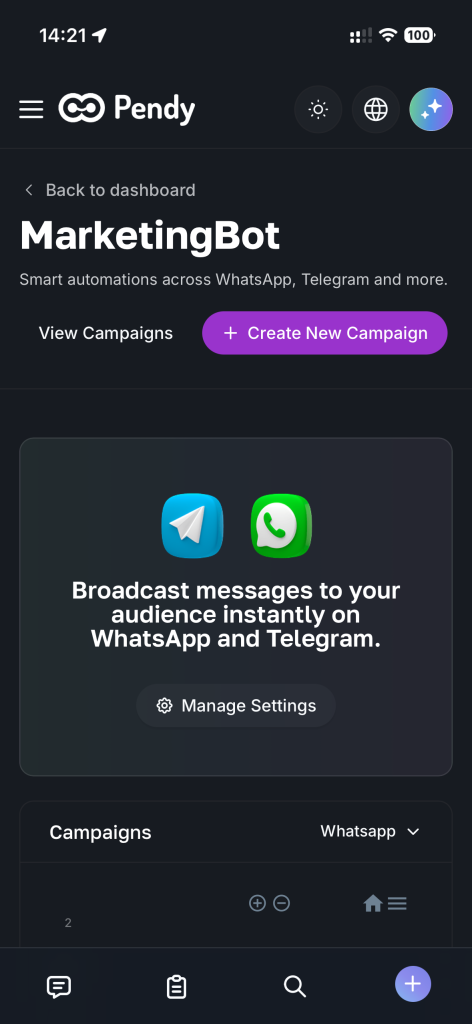
Instead of offering a standalone chatbot, Pendy provides an integrated AI ecosystem designed to help businesses automate customer communication, marketing, sales, and business operations from one platform.
With Pendy AI Chatbot, businesses can:
- Build human-like AI chatbots without complex development.
- Train AI using their own knowledge base.
- Support customers 24/7.
- Capture and qualify leads automatically.
- Route conversations to human agents when needed.
- Analyze chatbot performance through detailed analytics.
- Manage customer contacts in one centralized platform.
- Create reusable canned responses for faster operations.
- Organize conversations using categories and customer tags.
Beyond conversational AI, businesses can also expand into marketing automation, AI-powered social media management, AI content creation, and cloud deployment—all within the same ecosystem.
This integrated approach reduces operational complexity while giving teams the flexibility to scale as their business grows.
If you’re looking for an AI platform that goes beyond simple customer support, you can explore the complete ecosystem at https://pendy.io/.
The Future of Customer Engagement Is Intelligent
Artificial intelligence isn’t replacing human relationships—it is improving them.
Customers still value trust, empathy, and expertise. What AI changes is the speed and consistency with which businesses can deliver those experiences.
Companies that embrace conversational AI today are positioning themselves for a future where every customer interaction is faster, smarter, and more personalized.
Rather than waiting for customers to ask for help, AI can proactively guide them, answer questions instantly, recommend solutions, and connect them with the right people when necessary.
For businesses of every size, this represents a powerful opportunity to improve customer satisfaction while growing more efficiently.
The future of customer engagement isn’t about replacing people with machines.
It’s about giving every business a digital teammate that never sleeps, never stops learning, and is always ready to help.
Frequently Asked Questions
What is an AI chatbot?
An AI chatbot is a conversational assistant powered by artificial intelligence that understands natural language and interacts with customers much like a human. Unlike traditional rule-based chatbots, AI chatbots can answer complex questions, remember context, and continuously improve through training.
How can AI chatbots increase sales?
AI chatbots engage visitors instantly, recommend products, answer objections, qualify leads, and guide customers through the buying journey. This reduces abandoned inquiries and increases conversion opportunities.
Can AI chatbots replace human customer support?
Not entirely. The best approach combines AI with human agents. AI handles repetitive conversations, while human staff focus on complex issues, relationship building, and high-value sales.
What industries benefit most from AI chatbots?
AI chatbots are valuable across many industries, including e-commerce, SaaS, healthcare, education, finance, real estate, travel, hospitality, and professional services.
Why choose Pendy AI Chatbot?
Pendy AI Chatbot goes beyond automated replies. It enables businesses to build AI assistants trained on their own knowledge, manage customer contacts, analyze conversations, automate lead qualification, and integrate seamlessly with a broader ecosystem that includes AI Marketing Automation, AI Social Media Agent, AI Studio, and Pendy Cloud.
Final Thoughts
Customer expectations continue to evolve, and businesses that adapt will be the ones that thrive. AI chatbots are no longer a luxury reserved for large enterprises—they have become an essential tool for organizations that want to provide exceptional customer experiences while operating more efficiently.
By combining intelligent conversations, automated lead generation, knowledge-based responses, and seamless collaboration with human teams, AI chatbots can transform the way businesses communicate and grow.
Platforms like Pendy make this transformation accessible by bringing conversational AI together with marketing automation, social media management, AI-powered content creation, and cloud infrastructure in one unified platform.
Whether you’re a startup, a growing business, or an established enterprise, investing in AI today means building stronger customer relationships for tomorrow.
Discover how Pendy can help you automate customer engagement and grow your business with AI at https://pendy.io/.



 English
 Vietnamese